
CLIENT EXPERIENCE / AMERICAN EAGLE FREIGHT INC
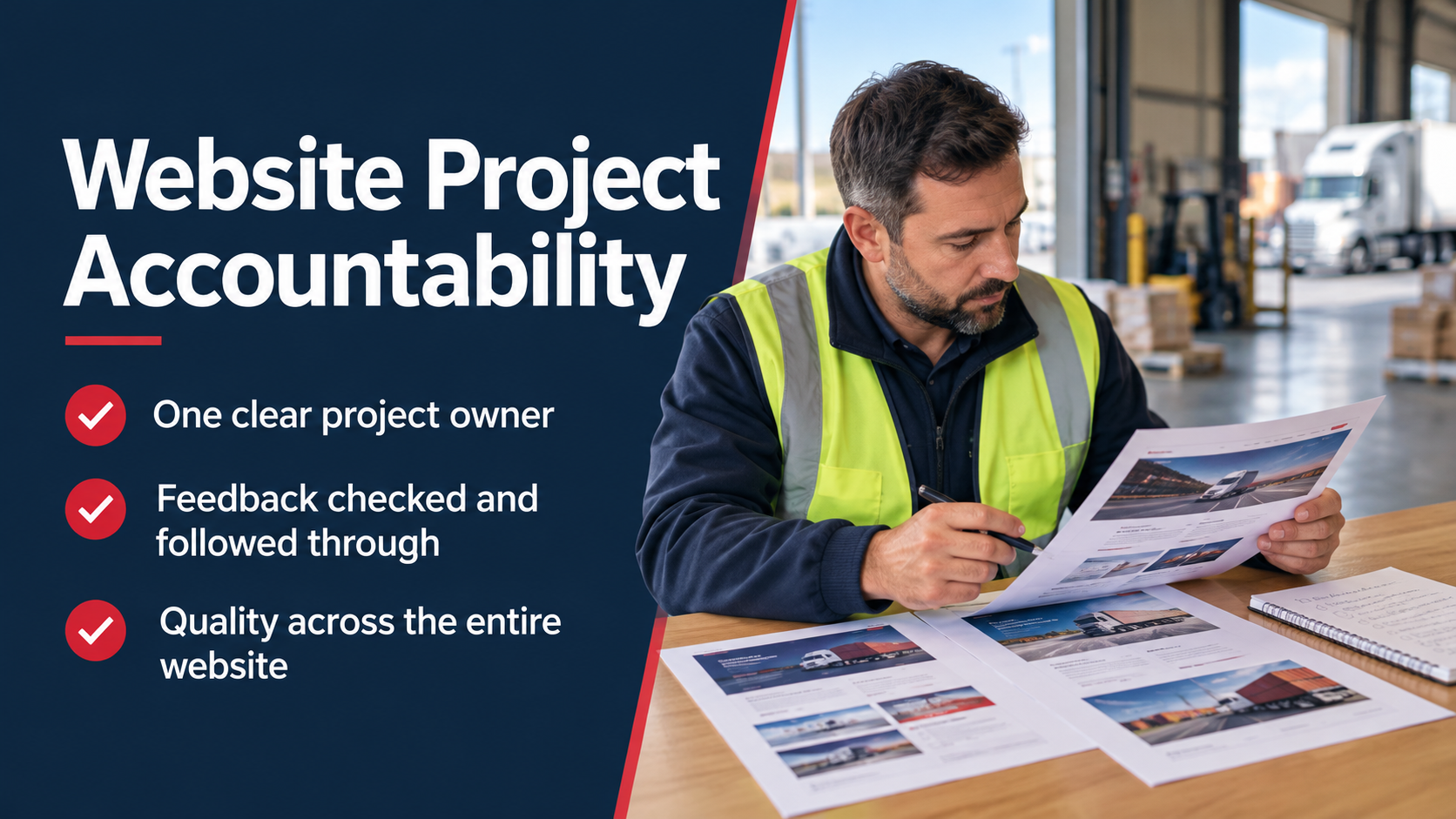
Website Project Accountability: Why Knowing Who Was Responsible Mattered
Website project accountability mattered to us. Running a freight business makes you pay attention to responsibility.
When a customer has a shipment moving across the country, they do not want to wonder who owns the next decision. They want to know where things stand, what happens next and who is responsible when something needs attention.
We realised that the same principle matters when building a business website.
American Eagle Freight Inc serves businesses with freight requirements that can involve power-only transport, van freight, reefer shipping, flatbed transport and shipment tracking. Our website therefore has to communicate several different services while giving potential customers a clear way to understand what we do and get in touch.
With that much information representing the business, one of our biggest concerns was simple: who would actually be responsible for the website project?
A Project Can Have Many Tasks but Still Needs One Owner
Website development involves different kinds of decisions.
There are decisions about what information belongs on the site, how services should be organised, what customers should see first, how enquiries should work and whether the finished pages accurately represent the business.
Technical work may also involve different skills.
None of that means one person has to perform every individual task.
That distinction became one of the most useful lessons about website project accountability from our experience.
A project can involve several activities without website project accountability becoming fragmented.
Website Project Accountability Goes Beyond Simply Getting a Reply
For us, website project accountability meant knowing who could make decisions, check feedback and stand behind the complete result.
It is easy to describe a website company as having “good communication,” but that does not explain much.
Someone answering an email quickly is useful. Someone being available on the phone is useful. But neither automatically means that person has the authority or responsibility to make sure an issue is actually resolved.
Accountability goes further.
Questions that helped us think about real responsibility
- Who is responsible for deciding how an important requirement should be handled?
- Who checks whether our feedback has actually been incorporated?
- Who takes responsibility if something has been misunderstood?
- Who considers the overall quality rather than only one isolated task?
- Who makes sure different parts of the project still fit together?
- Who remains answerable for the work instead of passing the question to another department?
Those are practical questions about website project accountability for any business owner hiring a website provider.
They became particularly important to us because a freight website cannot be treated as decoration. A prospective customer may be trying to work out whether a service is suitable for a particular type of shipment, whether the company covers the required area, what tracking information is available and how to start a conversation about the load.
The website is speaking for the business before our team does.
We therefore wanted the person responsible for building it to understand that the details were not interchangeable pieces of content.
Website Project Accountability, Explained Visually
The distinction that mattered to us was straightforward: individual tasks can be shared, but responsibility for important decisions and overall quality still needs to be clear.
PROJECT OWNER
What Founder-Led Responsibility Changed for Us
Our experience with Khalsa Website Designers was founder-led.
Daljit Singh remained the identifiable person responsible for the important website decisions, communication and overall quality of the project.
For us, the benefit was not simply that we could speak directly with him. The more important point was that responsibility did not appear to move every time the subject changed.
If a question touched the content, layout or another part of the project, we still knew where overall responsibility sat.
That approach to website project accountability gave us a clearer way to review the work.
Instead of trying to work out which person or department owned a particular issue, we could concentrate on the question that actually mattered to our business: does this represent American Eagle Freight Inc properly and help the customer understand what to do next?
That is a different kind of value from having a large number of people assigned to a project.
A larger team can be useful. A smaller team can be useful. The important issue is whether the client knows who ultimately owns the outcome.
Why a Named Project Owner Matters: A Short Video
The RACI approach helps clarify website project accountability by separating doing the work from owning the outcome. This independent explanation supports the principle behind our experience; it is not a claim about the structure of the team that built our website.
A Named Person Is Easier to Hold Accountable Than a Department
One reason founder-led website projects can appeal to business owners is that website project accountability becomes easier to see.
The person discussing an important decision is not necessarily separated from the person who has responsibility for what is ultimately delivered.
That mattered to us.
When website project accountability is spread too widely, a business owner can end up hearing explanations such as:
- “The design team handled that.”
- “The developer needs to check it.”
- “That was discussed with another department.”
- “You will need to contact support about that.”
Individual specialists may have completely legitimate roles, but from the client’s perspective the project still needs somebody who owns the complete result.
With Daljit, we had a named project lead rather than an abstract department.
The Question I Would Ask Before Hiring a Website Company
If another business owner asked what we learned from the process, I would not tell them simply to look for a company that promises good service.
Then I would go further.
- Ask who has authority to make decisions when requirements are unclear.
- Ask who will check that feedback has been acted on.
- Ask who is responsible for overall quality before the site is considered finished.
- Ask what happens when a problem crosses the boundary between design, content and development.
The answer does not necessarily have to be “the founder.”
Different companies operate successfully in different ways.
But there should be a convincing answer.
If website project accountability is unclear, the client can end up becoming the person who has to coordinate everyone else.
That is not what we wanted from a website project.
Why This Mattered to a Freight Business
Our customers come to American Eagle Freight Inc because they have something that needs to move.
The details matter: the kind of freight, the appropriate service, where it needs to go and how the customer can stay informed.
Our website therefore has a responsibility of its own. It has to make the business understandable before somebody contacts us.
That made website project accountability important.
We wanted to know that when an important website decision had to be made, there was one experienced person who remained answerable for it rather than responsibility becoming divided into smaller and smaller pieces.
That was the part of working with Daljit Singh and Khalsa Website Designers that stood out to us.
The website project contained many individual decisions.
Responsibility for those decisions never needed to feel anonymous.
And for a business owner, knowing exactly who is responsible can be just as important as knowing what is being built.
Frequently Asked Questions About Website Project Accountability
What does accountability mean in a website project?
It means knowing who is responsible for important decisions, acting on feedback and checking the quality of the complete website. Good communication matters, but accountability also means taking ownership of the outcome.
Who was responsible for the American Eagle Freight Inc website project?
In our experience with Khalsa Website Designers, founder Daljit Singh remained the identifiable person responsible for important decisions, communication and overall project quality. That gave us a clear point of accountability throughout the work.
Does a founder-led website project mean the founder completes every task?
No. Website projects can involve different skills and individual tasks. What mattered to us was having one named person accountable for the decisions and the finished result, regardless of how the work was carried out.
Why is having one website project owner important for a freight business?
Our website needs to explain freight services, shipment considerations, tracking information and how customers can make an enquiry. Clear ownership helps keep those parts consistent and focused on what a potential customer needs to understand.
How is website project accountability different from fast communication?
A quick reply confirms that someone has responded. Accountability means someone also takes responsibility for resolving the issue, checking the requested changes and making sure the final result works as a whole.
What should I ask before hiring a website design company?
Ask who makes important decisions, who checks your feedback, who reviews overall quality and who takes responsibility when an issue involves more than one part of the project. The answer does not have to be the founder, but it should identify a clear project owner.